


Save Money on Your Engagement Ring Now
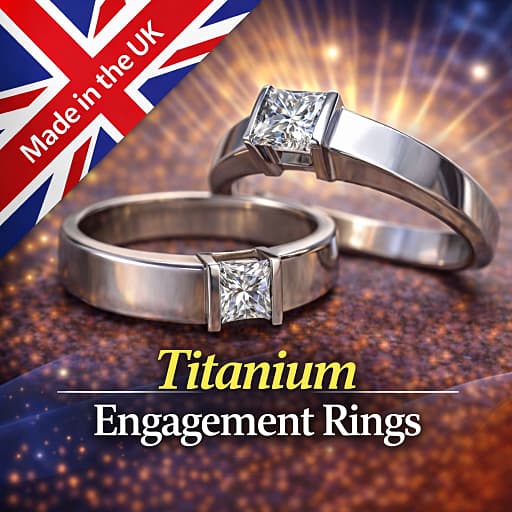
In this article, we will look at diamonds and exactly how we became so obsessed with them. This article was primarily intended to highlight our engagement rings made from titanium. The reason is their exceptional value for money, and when you read the following, it will make complete sense in light of the information conveyed here. The following information comes directly from The Truth About Diamonds, a popular presentation packed with startling revelations essential for those purchasing any diamond jewellery. We thank the authors for this. It begins here.
An expensive meal at a fancy restaurant, a declaration of romance and a big, fat diamond ring. This tradition is a pretty standard formula for an engagement proposal. After all, it has been ingrained in all of us that a diamond ring equals love and the bigger the diamond, the more love there must be.
Well, believe it or not, diamonds aren't all that rare. In fact, the reason diamonds cost so much is more due to savvy, sometimes unethical, business practices and incredibly successful advertising campaigns than to the stone's inherent value based on supply and demand. Something anyone who is trying to sell a diamond quickly comes to realise.
Here now is the story of how and why we fell in love with diamonds. The first known diamonds were discovered in India around 700 to 800 BC by the Dravidian people, who are still found today in Southern India and Sri Lanka. In fact, this is where we get the unit of weight for diamonds, carats. They would weigh the diamonds in relation to the seeds of a carob tree.
A brief history
Diamonds appear in ancient tales dating back at least 2,500 years, including those involving Alexander the Great and Sindbad the Sailor. Pliny the Elder in his 78 AD encyclopedia, Natural History, also spoke of diamonds. Eastern traders brought them to Europe along with silk, spices, and other exotic goods, using them as valuable trade items. But those ancient diamonds weren't the stunning, brilliantly cut stones we know today. They were dirty, rarely cut or polished correctly and were often quite dull. The dazzling stones recognised from modern times are put through labour-intensive cutting and polishing, which is where much of the real, albeit relatively small, value of all but the largest of diamonds derives.
As Joan Dickenson's book, The Book of Diamonds, put it, "Diamonds could lie around unnoticed for decades in the ground of India before a knowledgeable eye could spot a diamond in the rough." Even with diamonds being found in the jungles of Brazil in the early 19th century and India's contribution, the world's total production of gem diamonds was only a few pounds per year at that time. That amount all changed in 1869.
Before 1869, South Africa's main exports were wool and sugar. There was nothing there that interested Europe, hence why the Scramble for Africa, the nickname for the European takeover of Africa, didn't begin until 1881. So what changed? In 1866, a young Boer, a word referring to a South African farmer of Dutch or German descent, found a couple of carat diamond, for comparison, nearly half the size of the Hope Diamond, in a stream bed near the Vaal River in modern-day South Africa. Three years later, an 83-carat diamond was found by a shepherd boy near the Orange River in South Africa. Nicknamed the Star of South Africa, the diamond started off a rush in South Africa, with the British leading the way.
Soon after, four mines were dry dug, and the largest diamond deposit ever was found. The largest of these mines was called the Kimberly Mine or the Big Hole. Diamonds came out of those mines by the ton. The value of land in the region, and subsequently across the rest of Africa, shot up due to the hope that more diamonds could be found. A titanic struggle turned into a war for land between European powers, most notably Britain, and the Boer population who lived in the region. For four months between December 1880 and March 1881, the first Anglo-Boer War raged. The British would end up winning, but at a much higher cost of human resources than initially thought. 408 British soldiers were killed, while only 41 Boers were killed. 18 years later, the second Anglo-Boer War would commence with even higher casualties.
Meanwhile, the fighting and the sheer volume of diamonds from South African mines made the British owners quite nervous. The value of their products depended on scarcity and demand. With too many diamonds and the market fearful of the violence, demand was dropping, and diamond prices fell. In the late 1880s, diamonds were essentially a semi-precious stone, comparable to today's turquoise or topaz, and many of the mines were at risk of closure.
Corporative greed
Enter British native Cecil Rhodes, who got his start renting out water pumps to miners in 1869, at the beginning of the South African diamond rush. From the money earned, he bought up claims of land from smaller mining operations. When many small activities were closing and selling land due to diamond oversupply, Rhodes was buying. Ignoring the more established Kimberly Mine, he made the purchase that would go down in history. The old De Beer Mine was owned by two Boer brothers, Johannes Nicolaas De Beer and Diederik Arnoldus. Rhodes bought it off them at the time for a reasonable price. As Rhodes's empire continued to grow, the immensely wealthy Rothschild family, or at least their bank, provided some financial backing. It's unclear how Rhodes and Rothschild knew each other. And as every other South African mine levelled off, the De Beers mine did not.
In 1888, as diamond prices continued to fall, only a few mine owners remained, including Rhodes and his De Beers Mine. The remaining mine owners decided that the only way their industry would survive, instead of competing with one another, was to consolidate and form one giant mining company. The intention was to create a monopoly in the industry, centralising all the production, mining and land in the hands of one corporation. And that corporation was De Beers Consolidated Mines, LTD, headed up by Cecil Rhodes.
From that point forward, the De Beers Company was nearly the sole owner of every single South African mine. Rhodes and De Beers created separate subsidiaries and trading companies to make it appear as though they were independent companies operating separately. They were not and were all part of the parent De Beers Company. Today these would be called shell corporations and would be illegal in most regions of the world.
Essentially, what De Beers was able to do was set a single, fixed diamond price with minimal fluctuation across its subsidiaries and make it appear as though the market set the price. The actual supply and demand values no longer mattered because De Beers controlled all quantities. As the Atlantic put it in 1982, "De Beers proved to be the most successful cartel arrangement in the annals of modern commerce."
Upon Cecil Rhodes's death in 1902, De Beers owned 90% of the world's, not just South Africa's, diamond production. But after years of ruthless business practices, his company was about to be outsmarted. The Premier Mine, later called the Cullinan Mine after the town where it was located, was one of the few mines not owned by De Beers, despite overtures from the company to buy it. The owners didn't want to contribute to the De Beers monopoly, so instead, they sold to the independent dealers, the Oppenheimer brothers.
In 1905, the largest rough diamond ever found was discovered at the Premier Mine, weighing an absurd 3,106 carats. Now the Oppenheimer brothers, notably Ernest Oppenheimer, were in business. Ernest Oppenheimer knew that while his Anglo-American corporation was doing well, no one could defeat De Beers at that time.
Ernest Oppenheimer knew that while his Anglo-American corporation was doing well, no one could defeat De Beers at that time. So he took the expression, "If you can't beat them, join them," very seriously. Using his newfound wealth, he bought enough shares in De Beers to land himself a seat on the company's board. By 1926, he was the second-largest shareholder in the company, behind only Solly Joel. As it turns out, Joel and Oppenheimer were friends and had already conceived a plan where Oppenheimer would become chairman of the board. Oppenheimer did precisely this and renamed the company the Diamond Corporation. The Oppenheimers would hold control of the company until 2011.
In 1938, the diamond industry was again in decline, thanks to the discovery of mines in Australia, Siberia and Western Africa, and to the Great Depression, which reduced sales and left the market saturated. So Ernest sent his son, Harry, to New York City to meet with the ad agency, N.W. Ayer, which was the same agency that had helped their financial banker, Morgan Bank. Together, they realised that the United States was a significantly under-tapped market for diamonds. They just needed to figure out a way to convince Americans to buy their products. They did just that by using the happiest and perhaps occasionally most irrational of human emotions, love.
Using newspapers, magazines, the new medium of movies, and even a series of lectures at high schools across the nation centred around diamond engagement rings, they constructed the illusion that diamonds equalled love. With a bigger and more expensive diamond meaning more love. "A diamond is forever," was shown in ads depicting young lovers getting married or on their honeymoon. In truth, diamonds are easily shattered, burned and turned into carbon dioxide with the help of an abundant supply of oxygen. These ads appeared everywhere, often using big-name movie actors to foster this connection. And it worked. By 1944, diamond sales in the United States had increased by 55% over just a few years earlier and were now inextricably tied to love and marriage, and were also seen as a highly valuable item that would last forever.
The idea of diamonds as forever and as being passed down from one generation to the next was a particularly important notion. You see, as individuals held more and more diamonds, eventually there would be so many out there that if people started trying to sell them, the reality of the value would be discovered and the price of cut diamonds would also ultimately no longer be controllable by De Beers, something not lost on the company. Thus, not only had diamonds to be held forever by the individual, but the idea of buying a used diamond to show affection had to be a firm taboo.
Harry Oppenheimer commented on all this in 1971. "A degree of control is necessary for the well-being of the industry, not because production is excessive, or demand is falling, but simply because wide fluctuations in price, which have, rightly or wrongly, been accepted as normal in the case of most raw materials, would be destructive of public confidence in the case of a pure luxury such as gem diamonds, of which large stocks are held in the form of jewellery by the general public."
In any event, thanks to a virtual monopoly and perhaps the most effective ad blitz of all time, diamonds were here to stay, and again De Beers could set its price no matter if supply were high or low. In fact, now the higher the price, the more love one was demonstrating. De Beers repeated these types of campaigns throughout the developed world with resounding success. For instance, in Japan in 1967, diamond engagement rings were given by only 5% of the population. Within a decade, thanks to some savvy advertising, more than half of all engagement rings in Japan featured diamonds. That number has risen steadily ever since.
Today, thanks to a series of very recent events, including several lawsuits and something in the way of a revolt by several diamond-supplying nations against De Beers, De Beers no longer has a stranglehold on the diamond market. But the idea that diamonds are the traditional way to demonstrate true love and that one should spend two months' salary on a diamond engagement ring is embedded in popular culture by an old diamond ad campaign. First, it was one month's salary, and later it increased to two months' salary, with the slogan, "How else could two months' salary last forever," which has kept the diamond industry remarkably profitable. After all, even for those who know all about diamonds, thanks to widespread perception, giving the gift of a diamond is still the de facto way to convert money into a demonstration of love with no immediate end in sight.
Additional reading
The BEST Selection EVER of DIAMOND RINGS Online in the UK