


Celtic Art & Its Influence On Modern Day Celtic Jewellery
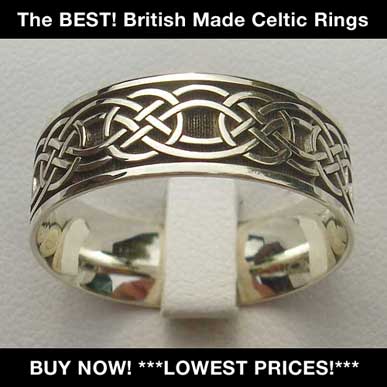
Buying UK-made Celtic Rings? We have the BEST! Information EVER on Celtic Art and its impact on our modern-day Celtic jewellery in the UK.
At Love2Have, we sell a considerable number of authentic Celtic rings made in the UK, mainly in gold or titanium. As our Celtic rings are so popular, we thought it would be a splendid idea to research this topic further by looking into the history of Celtic Arts and its relevance to the modern Celtic rings we make today. So here we have a condensed history of Celtic Art, symbolism and their meaning.
About our Celtic rings
Jewellery is as popular as ever before, and none more so than Celtic rings. The traditional fascination with all things Celtic remains crucial for many people and holds deep, significant symbolism for marriage. Celtic rings are always a popular choice for couples getting married, but modern fashions mean contemporary styling is available to customers, and as gold gets more expensive, alternatives are the only option for many, such as titanium, which is a brilliant choice for jewellery. Titanium is sturdy, hard-wearing and very versatile for Celtic ring design options.
Some Celtic history
The Celts themselves were a tribal race, but very fractured among themselves, with settlements spread across Europe. The tribes were not that tightly integrated with one another. However, they all spoke the same language and shared the same culture, which dates back to prehistoric times. It was the discontinuity among the tribes that would lead to the downfall of the Celts at the hands of the Roman Empire. Even though they were living well in Turkey and most of Western Europe, the mighty strength of the Roman armies soon conquered them.
People such as the Egyptians, the Vikings, and the Celts came into contact with one another and strongly influenced Celtic symbolism. When they encountered the Greeks, they were known as the 'Keltoi' and, in more familiar terms, as the 'Gauls' in ancient Rome. The Celts inhabited many parts of Europe from the 8th century to 1AD. The occupation of Europe by the Celts occurred in two phases. Firstly, between 750BC and 450 BC, in a region called Hallstatt, which we know as Austria. They then settled successfully in France, Britain, Spain and Italy. In the years from 450BC to 50AD, the second period covered a time of occupation of Switzerland.
Today, Celtic designs and patterns are associated with Ireland, where the Celts produced much of the art in the form of stone carvings and jewellery. In fact, even to this day, Ireland is probably best known for creating Celtic-inspired arts and crafts more than any other nation, including traditional Celtic wedding rings in the UK and Celtic engagement rings. The most famous of the Celtic designs used in wedding rings is the line of life - a Celtic knot pattern that represents the never-ending. The Celts had a real affinity with nature and based their designs on the animals they saw, including birds and fish.
It was the Greeks and Romans who taught us most about the Celts in earlier times, as they both traded with them and kept books. The Celts themselves did not write anything down. We have, however, learnt from archaeological digs that they made their cooking tools, weapons, pottery and also jewellery. Once the Celts flourished, more time was available for the development of their creative cultures, such as art and craft. They became adept at working with gold, silver, bronze and iron. It is from these beginnings that Celtic jewellery developed into the intricate designs used today. There was a high level of skill in creating beautiful items, such as armour and jewellery, for trade. Celtic designers used iron compasses to develop the varied designs. However, they were all based on circles intersecting. Wax was used to model the object's design, first to create a mould from clay, into which molten bronze was poured and left to set. Celtic designs mainly draw on the animal kingdom and plants. Shapes were crafted to resemble branches, and, most famously, the Isle of Man's three-legged symbol. Celtic culture eventually gave rise to Christianity, and their creative talents were used to produce religious books, most famously the Book of Kells. The beautiful designs were decorated with graphic images to convey the word of God to those unable to read.
Modern Celtic ring engraving
Advanced design techniques and engineering skills have allowed us to transcribe these ancient Celtic designs into smaller, intricate engravings for jewellery. These work none more so than on our engraved Celtic titanium rings. Celtic carvings can be copied and digitally adapted using computer systems to precisely carve using lasers.
Now that you have read the best article ever on Celtic Art, it's time you take a look and shop our collection of Celtic rings UK online in the UK!
Additional reading
Ogham Engravings, The Tree Alphabet & The Celtic History